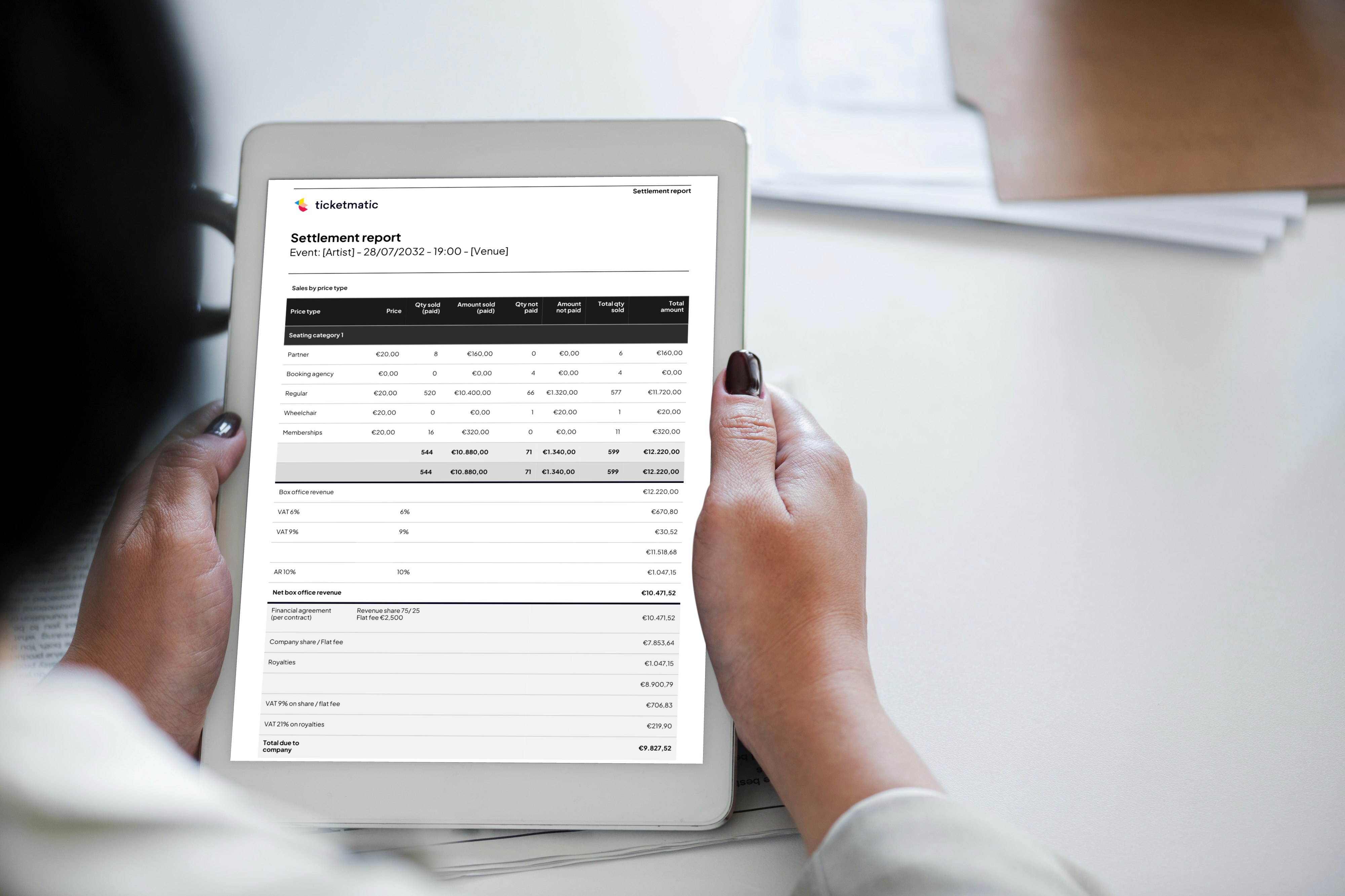

A settlement report looks simple enough on the surface: how many tickets were sold, how much revenue was generated, and what amount needs to be paid out.
In practice, it is often one of the most complex and financially sensitive documents a cultural organization produces. The settlement determines how the income from a performance is divided between the organizer, the artists, and the producers.
That division depends on a wide range of factors: contractual agreements, cost structures, service fees, subscriptions, discounts, VAT rules, and internal accounting requirements.
In many organizations, this complex financial logic is still calculated in Excel spreadsheets or through systems that lack flexibility and require manual steps in between. This makes the process error-prone and adds extra administrative work to a report that requires absolute financial accuracy.
It doesn't have to be that way. With ticketmatic Studio, settlement reports can be built entirely around how an organization works, directly inside the ticketing system itself. The financial logic is applied automatically based on ticket data, with no manual calculations or external spreadsheets required.
Why No Two Settlement Reports Look Alike
The goal of a settlement report is the same everywhere: account for the financial outcome of a performance. But the way that accounting is structured varies enormously from one organization to the next.
That's because a settlement reflects the full complexity of how a cultural organization operates. Among the factors that shape it:
- Contractual agreements with producers, co-production partners, or artist representatives. Performances may operate on a fixed buyout, a percentage of box office revenue, a minimum guarantee, or some combination of all three. The settlement must reflect exactly how income is divided under the terms of the contract.
- What counts toward the box office total. Organizations apply different rules to service fees, subscription tickets, discounts, and complimentary tickets. These decisions directly affect the revenue base used for distribution.
- Costs that are deducted before revenue is shared. Depending on the contract, certain costs — technical production, marketing, catering, venue hire — may be recovered before the remaining income is divided. In other agreements, they are not.
- The type and context of the organization. A cultural center that works primarily with fixed buyouts has different calculation needs than a music venue operating on revenue share. Co-productions, international tours, and different artistic genres each bring their own financial logic.
- Internal accounting requirements. Finance teams often have specific needs around VAT breakdowns, ledger codes, or reporting formats — all of which shape how a settlement is structured.
- Organizational history and established conventions. Many organizations have been working with a particular settlement structure for years, refining it over time. That history tends to have a strong influence on how the document is still built today.
Custom Settlement Reports, Built Into the Ticketing System
With ticketmatic Studio, that financial logic can be translated directly into the ticketing system itself. Settlement reports are built around how each organization actually works: contractual distribution terms, the treatment of service fees and subscriptions, cost recovery, VAT structures, reporting requirements, and any other organization-specific rules.
Beyond the calculations themselves, management interfaces are built that allow organizations to manage the settings that drive their settlements — revenue split terms, pricing components, financial agreements — directly within their ticketmatic account. Based on those settings, the system automatically applies the correct calculation model to the ticket data of each event.
The format and layout of the settlement can also be tailored to how organizations track and share their financial reporting, whether internally or with external partners. Generated reports can be exported or shared directly as PDF or spreadsheet.
The result is a settlement report that is no longer a document maintained alongside the ticketing system, but an integrated part of it. That brings several clear advantages:
- Accuracy. Calculations follow the agreed logic automatically, without manual intervention.
- Time saved. No more exports, copy-pasting, or manual checks.
- Ease of use. Settlements are generated within the same environment where ticket sales and reporting already happen.
- Long-term reliability. The calculation logic lives in the system, with clear settings that organizations manage themselves — rather than in fragile spreadsheets or institutional knowledge held by one person.
What that looks like in practice, of course, varies from one organization to the next. The following cases show how three different venues have automated their settlement processes with ticketmatic Studio.
Three Examples from the Field
Because settlement reports are closely tied to contracts and financial agreements, these examples do not go into the specific calculations or terms involved. What they do show is how organizations have used ticketmatic Studio to automate their settlement and reporting processes.
Ancienne Belgique
For Ancienne Belgique, ticketmatic Studio built a custom extension to their external sales dashboard. Partners and producers can now access ticket sales data and event statistics directly, without AB having to compile and send reports manually. The data can be accessed and exported at any time.
"The expansion of the external sales dashboard is a Studio development we've been eagerly anticipating. Ticketing today is a complex field, where we're constantly looking for the right balance between innovation, a personal, human touch and operational efficiency. Working with Studio has allowed us to streamline our operations by significantly reducing manual processes — freeing up time and energy for what really matters: our visitors." - Wati Koesharto, Coördinator Ticketing, Ancienne Belgique
De Blauwe Kei
At De Blauwe Kei, the challenge was accurately accounting for internal cost components — surcharges and other pricing elements that can vary by ticket type. ticketmatic Studio developed a tailored solution that allows these components to be managed directly within ticketmatic via dedicated settings and applied automatically in reporting. The organization no longer needs to make manual adjustments to its settlements.
De Nieuwe Oost
For De Nieuwe Oost, a custom solution was built to incorporate adjusted pricing into reporting for tickets sold through external pass partners. Rather than correcting these amounts manually in reports, the right prices are now applied automatically per ticket type — resulting in a more reliable revenue projection and a solid basis for invoicing partners.
Settlement Reports That Work the Way You Do
Curious about how your organization's settlement process could become simpler, more reliable, and less manual? Get in touch with our team to explore what's possible within ticketmatic.